
1-click, user-friendly employee feedback surveys.
Your employee clicks a single response in their unique employee satisfaction survey email. They then get back to work. So quick and easy for you to get regular ‘heartbeat’ information on employee satisfaction across the business.
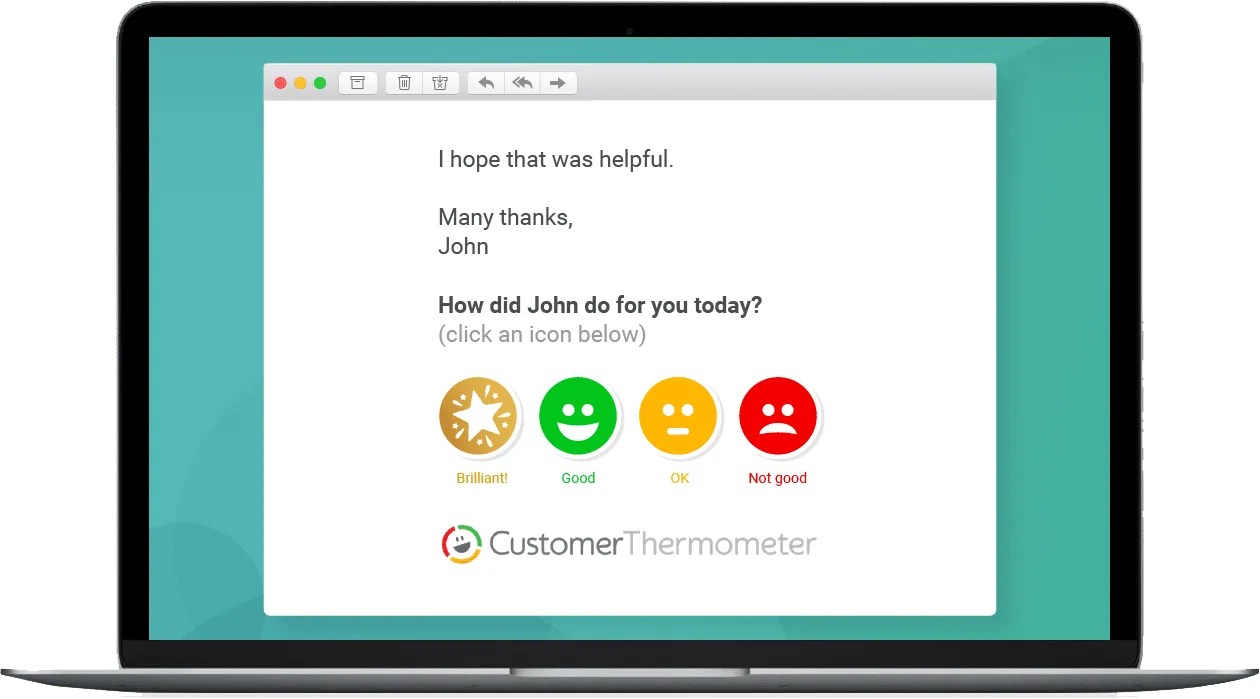

Our 1-click employee satisfaction surveys make it easy for employees to share regular feedback from wherever they are. Surveys are responsive and work across phones, tablets and other devices.
An annual employee satisfaction survey only gives you a snapshot of how people feel at one point in time. Regular employee pulse surveys help you keep track of satisfaction, spot changes and give employees more opportunities to tell you what’s working and what isn’t.
Customer Thermometer’s email signature surveys make employee feedback part of everyday communication. They’re brandable, quick to answer and offer a simple alternative to long employee surveys.
Take our employee satisfaction survey for a test drive.
Get an account and 10 surveys completely free.
- No credit card requiredOnce you’ve tested us out, upgrade and receive a monthly credit allowance.
- Fully functional accountStart sending surveys which get results, in the next 10 minutes.
- Be prepared for your response rateTake action on all your feedback – you might be surprised just how much you will get.
The market leader in engaging feedback

Employee survey reporting in real time
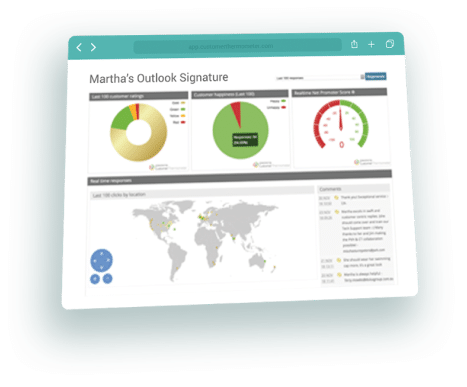
Turn employee feedback into useful, actionable insight with out-of-the-box reporting and real-time dashboards.
Track metrics including CSAT, NPS, TempTracking and league tables, view live comments, monitor targets and schedule reports for when you need them. You can also view or export your employee survey data, use webhooks to trigger actions in other apps, and connect feedback with the systems your teams already use through our integrations.

Award-winning customer service
We want every Customer Thermometer customer to get the most from our software and feel supported along the way.
Our support team has even earned the nickname the ‘Ministry of Magic’, reflecting the friendly, hands-on support we aim to provide. It’s all part of our goal to be a great company to work with and for.
Feedback no matter what size you are
From startups to global brands, thousands of customer-obsessed companies
in over 160 countries use Customer Thermometer




Customer Thermometer integrates with 100s of services
 gmail
 Zendesk
 Salesforce
 ServiceNow
 ConnectWise

What is an employee satisfaction survey?
An employee satisfaction survey measures how employees feel about their role, working environment and overall experience at an organization. It can help you understand areas such as job satisfaction, management, workload, recognition, career development, workplace culture and employees’ intentions to stay.
Rather than relying on assumptions, employee surveys give your workforce a direct way to tell you what’s working, what could be improved and how their experience is changing over time.
Why measure employee satisfaction?
Regular employee satisfaction surveys can help you identify both problems and positive changes in the employee experience.
- Spot changes in satisfaction – Workplaces can change quickly. A new initiative, change in responsibilities or management approach can affect how employees feel. Regular surveys help you identify changes before relying on an annual survey to uncover them.
- Understand what’s working – Employee feedback isn’t only about finding problems. Surveys can reveal improvements in morale, confidence, satisfaction and employees’ experience at work.
- Understand retention risks – Asking employees about workload, development, management, recognition and their intentions to stay can help identify areas that may be affecting retention.
- Give employees a voice – Regular feedback gives employees more opportunities to share their experiences and raise issues that might otherwise go unnoticed.
The feedback you collect can then be analysed over time to identify patterns and help inform improvements to the employee experience.
What is the difference between employee satisfaction and employee engagement?
Employee satisfaction and employee engagement are related, but they aren’t the same.
Employee satisfaction measures how content employees are with their job and workplace, including areas such as pay, workload, management, working conditions and benefits.
Employee engagement looks more broadly at an employee’s motivation, involvement and connection with their work and organization.
An employee can therefore be satisfied with their working conditions without necessarily feeling highly engaged with their role.
Measuring both can give you a broader picture of the employee experience and help you understand not only whether employees are happy, but how connected and motivated they feel.
What should an employee satisfaction survey measure?
Employee satisfaction can be influenced by many different parts of working life. What you measure should depend on what you want to understand, but common areas include:
- Overall job satisfaction
- Management and leadership
- Recognition and appreciation
- Pay and benefits
- Workload and work-life balance
- Career development and progression
- Training and resources
- Relationships with colleagues
- Workplace culture
- Communication
- Working environment
- Employee wellbeing
- Intention to stay with the organization
You can measure employee satisfaction at company, department or team level and compare results over time to identify patterns and changes.
Employee satisfaction survey questions and examples
The best employee satisfaction survey questions depend on what you want to learn. Keeping questions focused and grouping them around specific aspects of the employee experience can make the results easier to understand and act on.
Overall job satisfaction
- How satisfied are you with your current role?
- How satisfied are you with your overall experience working here?
- Do you feel proud to work for this organization?
- How likely are you to recommend this organization as a good place to work?
- Do you see yourself still working here in a year’s time?
Management and leadership
- Do you feel supported by your manager?
- Does your manager communicate clearly with you?
- Do you receive useful feedback from your manager?
- Do you feel comfortable raising concerns with your manager?
- Do you feel that your opinions and ideas are taken seriously?
Recognition and appreciation
- Do you feel your work is recognized and appreciated?
- Do you receive enough feedback about your performance?
- Do you feel your contribution to the organization is valued?
Career development
- Does your work contribute to your professional growth?
- Do you have opportunities to learn and develop new skills?
- Do you understand your opportunities for progression?
- Is your career developing in the way you expected?
- Do you feel appropriately challenged by your role?
Workload and wellbeing
- Is your workload manageable?
- How frequently do you experience work-related stress?
- Do you have the resources you need to do your job effectively?
- How satisfied are you with your work-life balance?
- Does your working environment suit the work you do?
Pay and benefits
- Do you feel you are paid fairly for the work you do?
- How satisfied are you with your employee benefits?
- Do you understand the benefits available to you?
- How important are your workplace benefits to your overall satisfaction?
Workplace culture
- Do you feel comfortable sharing feedback?
- Do you feel connected to your team?
- Do colleagues take your opinions and ideas seriously?
- Do you feel that communication across the organization is effective?
- Do you feel you can be yourself at work?
You don’t need to ask every question at once. Short employee pulse surveys can focus on one or two areas at a time, helping you collect regular feedback without asking employees to complete a lengthy questionnaire.
How to create an employee satisfaction survey
A useful employee satisfaction survey starts with a clear idea of what you want to understand.
- Decide what you want to measure – Choose specific areas such as overall satisfaction, management, workload, recognition or career development.
- Choose focused questions – Avoid trying to measure every aspect of the employee experience in one survey.
- Use clear and consistent response options – Rating scales make it easier to compare responses and track changes over time.
- Give employees an opportunity to add context – Follow-up questions and comments can help explain why someone gave a particular response.
- Consider anonymity and confidentiality – Employees need to understand how their responses will be used and whether they can be identified.
- Survey regularly – Regular pulse surveys can help you identify changes that a single annual survey might miss.
- Act on the feedback – Analyse the results, share relevant findings and communicate what happens next.
How often should employee satisfaction surveys be conducted?
Employee satisfaction surveys are most useful when they are conducted regularly rather than relying solely on one annual survey.
An annual employee survey provides a snapshot of how employees feel at one point in time. Shorter monthly or quarterly pulse surveys can help you monitor changes, identify emerging issues and compare results over time.
The right frequency depends on your organization and what you are measuring. The important thing is to survey consistently enough to establish a benchmark and identify meaningful changes.
If you want to compare results from one survey to another, keep the wording and response options consistent. Changing the question can make it difficult to make a like-for-like comparison.
What is the best format for an employee satisfaction survey?
The best employee satisfaction surveys are simple, focused and easy to answer.
Avoid jargon and corporate language. Write questions in plain English and make it immediately clear what you are asking employees to rate.
Short surveys can also make regular feedback easier to fit into the working day. Instead of asking dozens of questions at once, you can use employee pulse surveys to explore different aspects of the employee experience over time.
Confidentiality is also important. Be clear about whether responses are anonymous or identifiable, how the information will be used and who will have access to it. Employees are more likely to give useful feedback when they understand the process and feel comfortable answering honestly.
Employee satisfaction survey best practices
A few simple principles can make employee satisfaction surveys more useful:
- Keep questions clear, concise and focused on one topic at a time.
- Avoid leading questions that encourage a particular answer.
- Keep rating scales and question wording consistent when tracking changes over time.
- Explain whether responses are anonymous or confidential.
- Avoid overwhelming employees with unnecessary reminders.
- Give employees an opportunity to explain their responses where useful.
- Analyse written comments alongside quantitative scores to understand the context behind the data.
- Share relevant findings after the survey rather than letting feedback disappear into a dashboard.
- Make it clear what actions, if any, will be taken as a result of the feedback.
- Give employees enough time to respond without leaving surveys open indefinitely.
Collecting feedback is only useful if you do something with it. Regular employee satisfaction surveys can help you understand how people feel, identify changes over time and give employees a simple way to share their experiences.
Create an employee satisfaction survey with Customer Thermometer
Customer Thermometer makes it easy to collect regular employee feedback with short, one-click surveys.
Create your survey, collect feedback across the employee experience and use real-time reporting to understand how sentiment changes over time.
Start your free trial and try Customer Thermometer for yourself.
You can also see how our survey software works or contact our team if you have any questions.
Employee Satisfaction Survey FAQs
What is an employee satisfaction survey? +
An employee satisfaction survey is a questionnaire used to understand how employees feel about their job and workplace. It can measure areas including overall job satisfaction, management, workload, recognition, career development, workplace culture and employee wellbeing.
What should an employee satisfaction survey measure? +
An employee satisfaction survey can measure overall satisfaction as well as specific parts of the employee experience, including management, recognition, pay and benefits, workload, career development, communication, culture and working conditions.
What questions should I ask in an employee satisfaction survey? +
Useful employee satisfaction survey questions focus on specific aspects of working life. Examples include “How satisfied are you with your current role?”, “Do you feel supported by your manager?”, “Is your workload manageable?” and “Do you feel your work is recognized and appreciated?”
How often should you run an employee satisfaction survey? +
The right frequency depends on what you want to measure. An annual survey can provide a broad snapshot, while shorter monthly or quarterly pulse surveys can help you monitor changes and identify emerging issues throughout the year.
What is the difference between employee satisfaction and employee engagement? +
Employee satisfaction describes how content employees are with their job and working environment. Employee engagement looks more broadly at their motivation, involvement and connection with their work and organization. The two are related but measure different aspects of the employee experience.
Should employee satisfaction surveys be anonymous? +
Employee satisfaction surveys can be anonymous where appropriate, particularly when asking about sensitive workplace experiences. Whether a survey is anonymous or identifiable, employees should be clearly told how their responses will be used, who can access them and whether individual responses can be traced back to them.
(Post last updated October 1, 2026)